Sustainability Strategy
Environmental Strategy
Sustainability
Approach
Across the entire supply chain, we are working to reduce CO₂ emissions and promote a circular business model, with the aim to help achieve both a carbon-neutral society and a circular economy.
External Environment
Due to the impacts of climate change, the environment surrounding our business is undergoing major changes. There is a growing awareness of the need to reduce environmental impact throughout the supply chain, and the demand for EVs, hybrid vehicles, and cars incorporating the latest technologies continues to rise. In addition, the importance of the circular economy is increasing, with greater expectations for environmentally friendly vehicles and sustainable mobility services.
Current Situation and Challenges
To respond to changing customer needs resulting from shifts in the external environment, it is essential to develop charging infrastructure and promote resource circulation through vehicle reuse and other initiatives. It is also important to reduce environmental impact, improve cost efficiency, and build a sustainable business model while maintaining competitiveness, by leveraging technological innovation and responding swiftly to market changes.
Initiatives toward Decarbonization
-
Scope 1:
Optimization of the Number of Company Vehicles and Promotion of EV Adoption
-
Scope 2:
Transition to Electricity Derived from Renewable Energy Sources
-
Scope 3:
Support Activities to Promote the Introduction and Widespread Use of EVs among Customers
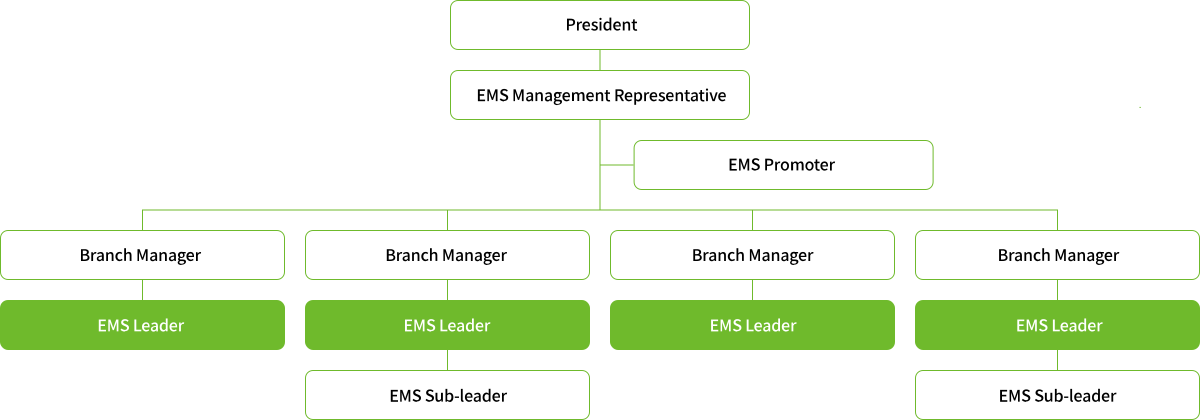
Environmental Management System (EMS) Structure
Interview with the Head of EV
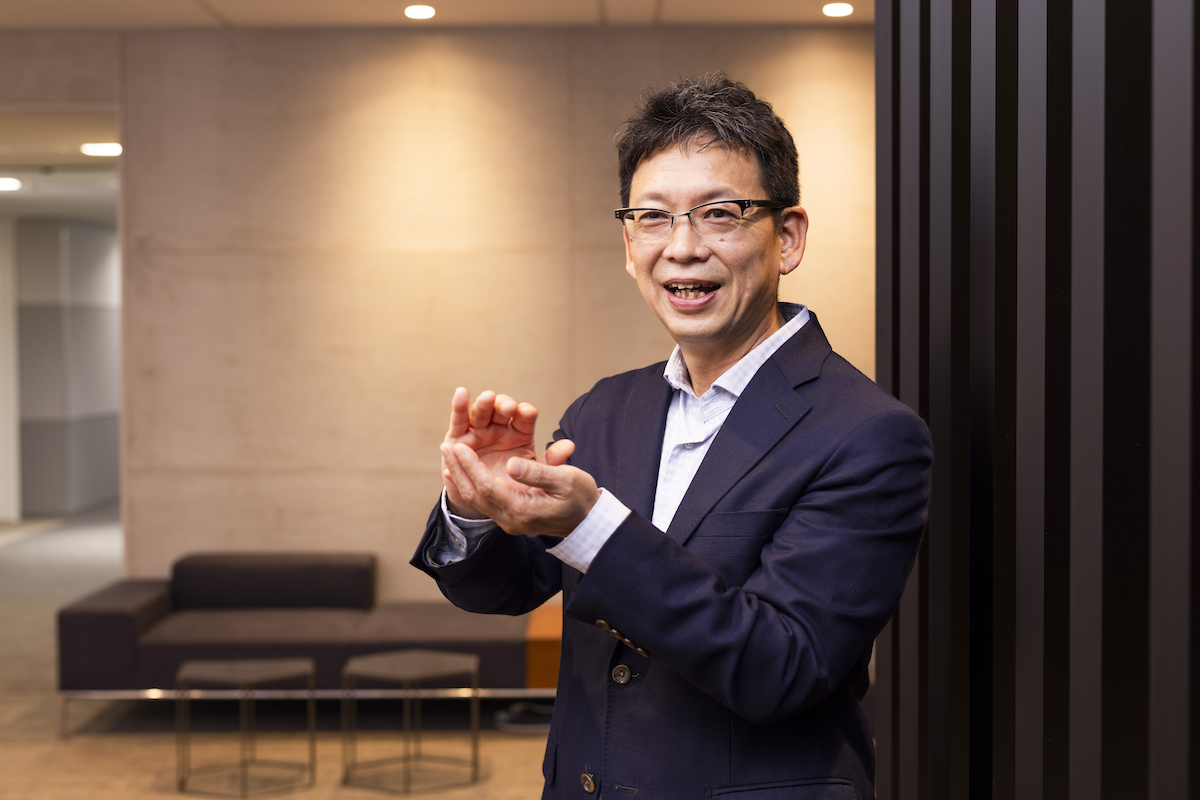
Becoming a Leading Company toMake SMAS Synonymous with EVs
Ryuji Kodama
Deputy General Manager of Sales Strategy Division
*The position is as of September 2025.
Read the message from the head of EV
Global EV Trends and the Current Situation in Japan
In April 2025, I had the opportunity to visit the Shanghai Motor Show and witnessed firsthand the reality of EV development in China. In terms of price, features, driving range, and even design, Chinese EVs have surpassed those made in Japan. Nearly every vehicle running through central Shanghai was an EV; there, electric vehicles have already become the norm. In contrast, what is the situation in Japan today? There remain many challenges to overcome, such as the development of charging infrastructure, and the pace of EV adoption is slower compared to the rest of the world. Of course, if we look globally, the speed has also been affected by US tariff policies, but even so, the movement toward electrification is unstoppable. We are confident that our direction and initiatives toward EVs are correct, and even if the path ahead is challenging, it is vital that we continue to move forward and take the lead within the industry.
Shifting from the Demonstration Phase to the Implementation Phase
In the previous fiscal year, to advance our EV and carbon-neutral strategies, we held SMAS e-PARK events across seven prefectures in Japan, expanding our business collaborations with local governments. Going forward, we will shift gears from the demonstration phase, where customers see and experience EVs firsthand, into the implementation phase. Until now, our focus has primarily been on encouraging customers to adopt EVs, viewing them as individual points of activity. From here on, we aim to connect those points into a continuous line, positioning EVs as one of the key means toward achieving carbon neutrality, and integrating this perspective into our own corporate initiatives as well.
Contributing to the Development of the Automotive Society and the Improvement of the Global Environment
Our goal is not merely to promote the widespread use of EVs. As mentioned earlier, EVs are a means to an end; the essence of our mission lies in our management philosophy: to contribute to the development of the automotive society and the improvement of the global environment. It is vital that each of us embodies this spirit, working to address our customers’ management challenges in the field of mobility and linking those efforts to broader social contribution, while proposing optimal solutions that meet their needs.
SMAS as Synonymous with EVs
In my daily work in sales, I often hear customers say things like, “It’s still too early for EVs,” or “We should wait and see.” On the other hand, I have never once heard anyone say, “I’m not interested in doing good things for the environment.” In other words, many customers are interested in EVs, but simply don’t know where to begin. There may be no perfect answer, but by understanding each customer’s situation and addressing their management challenges one by one, without limiting ourselves strictly to leasing, we can guide them toward effective solutions. At times, it may be necessary to adopt what is best suited to the customer’s needs not all at once, but rather in a partial optimization manner. To that end, in fiscal 2025 we launched SMAS Green-Lab., a new training and human resource development program designed to enhance climate change literacy and promote contributions to a decarbonized society. By improving employees’ literacy, we aim to shift from simple sales to true consulting. Through continued cooperation both inside and outside the Company, we will keep exploring ways to overcome barriers to EV adoption. I firmly believe that the day is not far off when SMAS will be recognized as the leading company synonymous with EVs.
CLOSE
Launch of SMAS Green-Lab.
SMAS Green-Lab.: Human Resource Development Program for Enhancing Climate Change Literacy and Contributing to a Decarbonized Society
We have launched a new training and human resource development program, SMAS Green-Lab., designed to enhance climate change literacy and promote contributions to a decarbonized society. This initiative aims to deepen each employee’s fundamental understanding of climate change while strengthening their ability to make environmentally conscious business proposals.
Starting with the Sales Unit, we plan to expand the program company-wide and establish it as a continuous, effective framework for the future.
Recognizing the Challenges Behind the Initiative
For the Company, efforts to address climate change and promote decarbonization are not merely matters of social responsibility, but they are essential perspectives for future business growth. To enhance our corporate sustainability, it is vital that employees understand why pursuing decarbonization is necessary now and recognize how their individual work connects to environmental issues. For this reason, we are working to establish a strong foundation for improving environmental literacy among our employees through the development of comprehensive education and training systems.
Introduction to the Initiative by SMAS Green-Lab. Representatives

SMAS Employees Explain the Mission of SMAS Green-Lab.
Takako Morimoto (left) and Yuka Sato (right)
EV & Carbon Neutral Strategy Promotion Department and Corporate Sustainability Department, Sales Strategy Division
*The position is as of September 2025.
Learn more about SMAS Green-Lab.
Overview and Objectives of SMAS Green-Lab.
SMAS Green-Lab. is a training and human resource development program designed with the following three main objectives.
-
1. Acquiring Foundational Knowledge on Climate Change and Decarbonization
This program supports systematic learning about the mechanisms of climate change, international frameworks such as the Paris Agreement, policies and systems related to decarbonization, and topics such as EVs. -
2. Enhancing Proposal Capabilities from a Decarbonization Perspective
Participants develop the ability to propose optimal combinations of the Company’s diverse services, including EVs, mobility services, RMS (Risk Management Solutions), and BPO (Business Process Outsourcing), from the standpoint of decarbonization, with the goal of maximizing customer value.
The program goes beyond the acquisition of knowledge, emphasizing a practical perspective on how to connect the global challenge of climate change to the Company’s business activities. -
3. Supporting the Acquisition of the Ministry of the Environment–Certified Decarbonization Advisor Qualification
As part of our concrete initiatives for human resource development, the Company actively promotes the acquisition of the Decarbonization Advisor qualification certified by Japan’s Ministry of the Environment. This certification serves as proof that employees possess recognized expertise and practical skills accredited by an external institution, enabling them to play a highly trusted role in future customer-facing proposals and inter-company collaborations.
In support of certification acquisition, we will establish a comprehensive and ongoing support system, including developing internal learning support frameworks, financial assistance for examination fees, and post-certification support to facilitate practical application in the workplace.
Future Outlook
SMAS Green-Lab. is a program designed not only for the Sales Unit but also with expansion to the Head Office, Service Unit, and the entire company in mind. Going forward, as a cross-departmental initiative, we aim to raise climate change literacy across the organization. Through this, each employee will develop a mindset that incorporates sustainability into their own work, enhancing the Company’s overall environmental responsiveness.
CLOSE
Response to Carbon Neutrality
The Company is advancing decarbonization initiatives across three scopes, Scopes 1, 2, and 3, with the goal of achieving carbon neutrality by 2050.
-
Scope 1:
Optimization of the Number of Company Vehicles and Promotion of EV Adoption
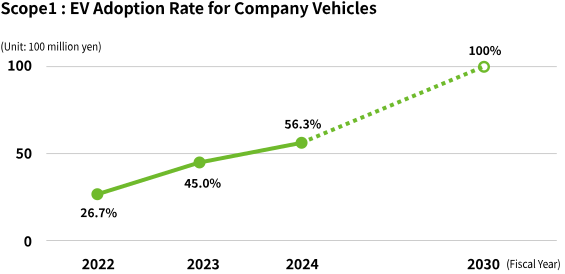
Scope 1 covers direct emissions resulting from the use of company vehicles. Under our management philosophy of contributing to the development of the automobile society and the improvement of the global environment, we are actively pursuing initiatives toward realizing a decarbonized society. As part of these efforts, we are promoting the reduction of our company vehicles by utilizing our own Vehicle Optimization Services. In addition, as a member of the automotive industry, we believe it is important to demonstrate leadership in reducing CO2 emissions. For this reason, we are accelerating the adoption of EVs for our company vehicles. In FY2024, 56.3% of our company vehicles were replaced with EVs. We aim to reach 61% by FY2025 and 100% EV adoption across all our vehicles by FY2030.
-
Scope 2:
Transition to Electricity Derived from Renewable Energy Sources
Scope 2 covers indirect emissions associated with the use of electricity and heat at company offices. Since all of our offices, including our head offices, are located in tenant buildings, it can be challenging to switch to electricity from renewable sources. Nevertheless, we are actively engaging with building owners to enable as many offices as possible to use renewable energy. In FY2024, our renewable energy adoption rate reached 55.8%, and CO2 emissions associated with electricity use were reduced by 11.6% compared with FY2023, thanks to the increased renewable energy adoption rate.
| 100% renewable energy | Partially renewable energy | |
|---|---|---|
| Sumitomo Mitsui Auto Service | Tokyo Head Office, Osaka Head Office, Minami-Tohoku Branch, Chiba Branch, Nagoya Branch, Toyama Branch, Kyoto Branch, Kobe Branch, Himeji Branch, Okayama Branch, Takamatsu Branch, Kumamoto Branch | Yokohama Branch |
| Ace Auto Lease | Kansai Branch | Head Office |
| Cedyna Auto Lease | Tokyo Head Office, Osaka Sales Department | ー |
| Mazda Auto Leasing | Shizuoka Branch, Osaka Sales Department | ー |
*As of September 2025
-
Scope 3:
Support Activities to Promote the Introduction and Widespread Use of EVs among Customers
Scope 3 covers indirect emissions from Categories 1, 2, 3, 5, 6, 7, and 13. Although these emissions are not directly generated by the Company, they account for a large portion of emissions across the entire supply chain. In particular, reducing GHG emissions from Category 13 (downstream leased assets), is essential for achieving a decarbonized society. To address this, we provide customers with comprehensive support for EV adoption, including planning and peripheral services, through our EV One-Stop Service. This initiative actively promotes the adoption and widespread use of EVs in automobile leasing and contributes to CO2 reduction across the entire supply chain.
Response to Circular Economy
Our circular economy initiatives focus on sustainable procurement and support for customers' sustainable use of vehicles. At SMAS, more than 70,000 lease vehicles reach the end of their term each year, and many are reused as high-quality used cars. We also actively promote the use of green parts to reduce environmental impact during vehicle maintenance and parts replacement, while supporting sustainable vehicle operations.
Response to Climate Change (Disclosure Based on TCFD Recommendations)
We place strong emphasis on monitoring the impacts of climate change and strengthening our EV leasing business with a forward-looking perspective, given our role in supporting the automobile industry’s transition to decarbonization. From a medium- to long-term viewpoint, we conducted analyses based on multiple scenarios, including the below 2°C scenario. Under both the 1.5°C and 4°C scenarios, climate-related risks to the Company are relatively limited. However, because the 1.5°C scenario presents a significant business opportunity for us, we are strengthening our strategies to expand the adoption of EV leasing as part of our decarbonization efforts.
| Scenario | Key issues | Classification | Impact on SMAS | |
|---|---|---|---|---|
| Short-term | Medium-/long-term | |||
| 1.5°C scenario | Climate change (carbon neutrality) |
Risk | Low | Low |
| Opportunity | Low | High | ||
| Resource circulation (circular economy) |
Risk | Low | Low | |
| Opportunity | Low | High | ||
| 4°C scenario | Natural disasters | Risk | Low | Low |
| Opportunity | Low | Low | ||
| Natural environment and biodiversity | Risk | Low | Low | |
| Opportunity | Low | Low | ||
Related Contents